Might & Magic Heroes Board Game: A Comprehensive Guide to Strategic Fantasy Gaming
The world of tabletop gaming has witnessed a remarkable transformation in recent years, with beloved video game franchises making their way onto dining room tables worldwide. Among these adaptations, the Might & Magic Heroes board game stands as a testament to how digital strategy experiences can be successfully translated into tactile, face-to-face gameplay. This physical incarnation of the legendary Might & Magic universe brings together everything fans adore about the franchise: epic fantasy battles, strategic depth, hero development, and kingdom building, while introducing innovative mechanics that make the most of the board game medium.
For those unfamiliar with the source material, Might & Magic represents one of the most enduring fantasy gaming franchises, with roots stretching back to the 1980s. The Heroes of Might and Magic series, in particular, has captivated strategy enthusiasts for decades with its turn-based tactical combat, resource management, and exploration elements. The board game adaptation seeks to capture this essence while providing a more social, unplugged gaming experience that brings players together around a shared battlefield. Understanding what makes this adaptation special requires examining its mechanics, strategic depth, component quality, and how it compares to both its digital predecessors and other fantasy board games on the market.
Understanding the Core Gameplay Mechanics and Strategic Framework
The Might & Magic Heroes board game operates on a foundation of interconnected systems that reward both tactical thinking and long-term strategic planning. At its heart, the game revolves around controlling heroes who lead armies across a fantastical landscape, conquering territories, gathering resources, and ultimately competing to achieve victory conditions that vary depending on the chosen scenario. Unlike many simplified board game adaptations of video games, this title maintains much of the complexity that made the original series compelling, translating computer-managed calculations into streamlined physical mechanics that players can execute with cards, dice, and tokens.
Each player begins by selecting a faction and a hero character, both of which significantly influence their strategic approach throughout the game. The faction choice determines the types of units available for recruitment, the special abilities accessible, and the general playstyle that will prove most effective. Some factions excel at aggressive early expansion, flooding the map with numerous weak units that can overwhelm opponents through sheer numbers. Others favor a more defensive posture, building fewer but more powerful creatures that can hold key positions while economic engines generate the resources needed for eventual dominance. The hero selection adds another layer of customization, as these characters possess unique abilities that can synergize with faction strengths or shore up weaknesses, creating hundreds of possible combinations that ensure no two games feel identical.
The turn structure in the Might & Magic Heroes board game balances simplicity with meaningful choices. During each round, players take turns performing actions that might include moving heroes across the map, engaging in combat encounters, constructing buildings in controlled towns, recruiting new units, or casting spells from their accumulated magic reserves. The action economy system ensures that players must prioritize their objectives carefully; attempting to do everything at once spreads resources too thin, but focusing too narrowly leaves vulnerabilities that observant opponents will exploit. This creates natural tension as players weigh immediate tactical gains against long-term strategic positioning, a hallmark of excellent strategy game design.
Resource management forms the economic backbone of the gameplay experience. Players must collect and manage multiple resource types, each serving distinct purposes within the game’s economy. Gold represents the universal currency, required for almost every action from recruiting troops to constructing buildings. Special resources like ore, wood, crystals, and gems enable the construction of advanced structures and the recruitment of elite units. Managing these resources effectively requires planning several turns, as many powerful options demand combinations of different resource types accumulated over multiple turns. The scarcity of these resources, combined with competition from other players seeking the same objectives, creates dynamic tension throughout the game as players decide whether to expand their resource production, invest in immediate military strength, or pursue other strategic paths.
Combat System: Tactical Depth and Army Composition Strategies
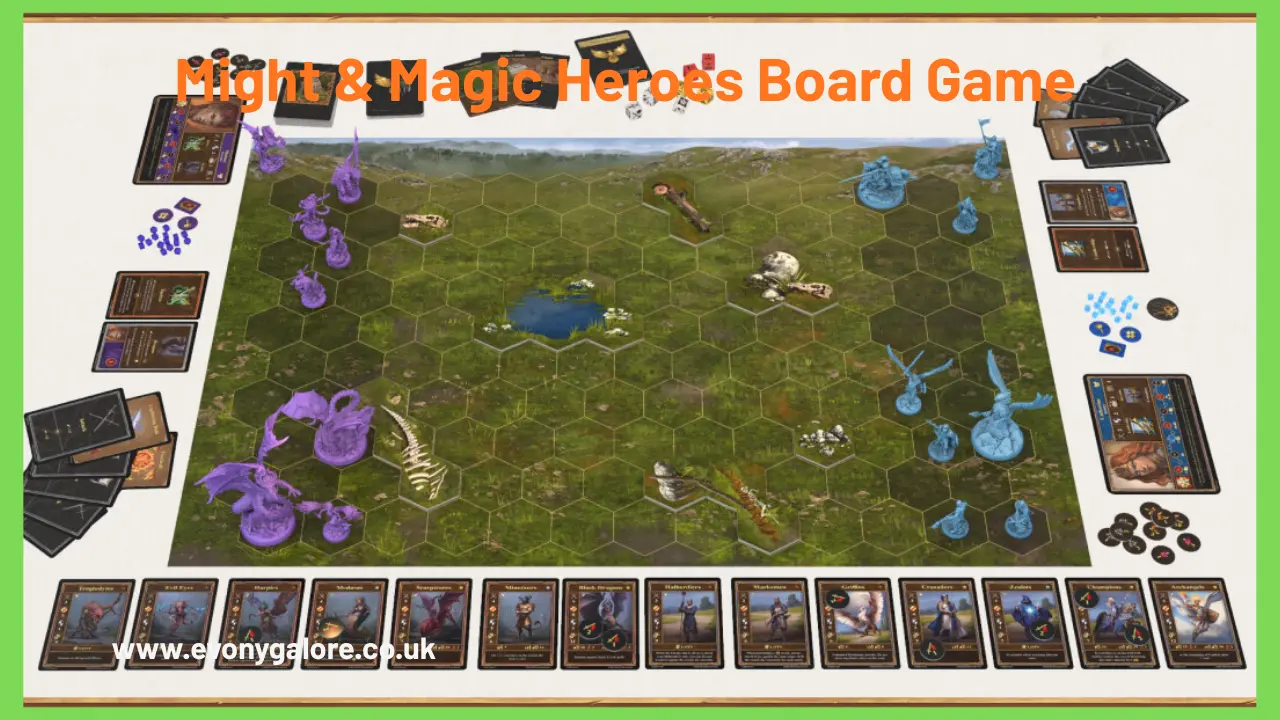
Combat represents the most dramatically engaging aspect of the Might & Magic Heroes board game, where careful army composition and tactical decision-making determine the outcome of critical battles. Unlike simpler combat systems that rely purely on comparing numerical values, this game implements a sophisticated tactical combat grid where unit positioning, special abilities, and timing create a rich decision space reminiscent of the video game series. When two forces clash, players transition to a dedicated combat board where they deploy their units and execute turn-based tactical maneuvers until one side emerges victorious or retreats from the battlefield.
The combat grid system deserves particular attention because it elevates the game beyond simple dice-rolling competitions. Each unit type occupies specific spaces on the grid and possesses unique movement ranges, attack patterns, and defensive capabilities. Ranged units like archers and mages can strike from a distance but crumble quickly in melee combat, requiring protection from front-line troops. Cavalry units might possess superior mobility, allowing them to flank enemy formations and target vulnerable backline units. Heavily armored infantry serves as defensive anchors, holding critical positions while absorbing enemy attacks. This rock-paper-scissors dynamic, multiplied across numerous unit types with special abilities, creates combat scenarios where strategic composition matters as much as raw numerical superiority.
Hero involvement in combat adds another dimension of strategic depth. Heroes don’t simply observe battles from the sidelines; they actively participate, casting spells, inspiring troops, and sometimes engaging in direct combat. The spell system allows heroes to dramatically alter battlefield conditions, potentially turning seemingly hopeless battles into victories through clever magical intervention. Offensive spells might rain lightning down on enemy formations or curse opposing units with debilitating effects. Defensive magic can create protective barriers around friendly troops or heal wounded units mid-battle. Utility spells might manipulate the battlefield itself, creating obstacles that channel enemy movement or removing terrain features that provide defensive bonuses. Managing the hero’s limited magical energy throughout a turn requires careful consideration. Expending all magic on one battle might secure an important victory but leave the hero vulnerable in subsequent encounters.
Key Action Considerations for Competitive Play:
- Army composition balance: Successful players maintain diverse forces rather than recruiting only the most powerful available units. A balanced army can adapt to various combat scenarios, while specialized forces excel in specific situations but struggle when facing counter-strategies.
- Initiative and turn order: Understanding which units act first in combat provides significant advantages. Fast-moving scouts and cavalry can eliminate enemy ranged units before they fire a single shot, while slow, heavily armored units might never reach the battlefield’s far side against mobile opponents.
- Terrain utilization: The combat system incorporates terrain features that provide defensive bonuses, movement restrictions, or other tactical considerations. Positioning ranged units on elevated terrain increases their range, while forests provide cover that reduces incoming damage.
- Retreat timing: Knowing when to retreat preserves valuable units for future battles. A pyrrhic victory that destroys most of your army might leave you vulnerable to other players, making strategic withdrawal the wiser choice in certain circumstances.
- Spell timing and targeting: Effective spell usage requires identifying critical moments when magical intervention provides maximum impact. Wasting powerful spells on minor skirmishes leaves heroes defenseless during decisive battles that determine the game’s outcome.
Faction Diversity and Asymmetric Gameplay Opportunities
One of the most celebrated aspects of the Might & Magic Heroes board game lies in its faction design philosophy, which embraces asymmetric gameplay rather than offering cosmetically different but mechanically identical options. Each faction possesses a distinct identity reflected through unique unit rosters, special abilities, economic bonuses, and strategic strengths that fundamentally alter optimal gameplay approaches. This design choice dramatically enhances replayability while ensuring that players develop specialized expertise with their favorite factions while remaining challenged when exploring unfamiliar ones.
The Haven faction exemplifies the classic “good” fantasy archetype, featuring knights, angels, and holy magic. Their units tend toward balanced statistics with strong defensive capabilities, making Haven particularly forgiving for newer players while still offering strategic depth for veterans. The faction’s special abilities often involve healing, protective magic, and morale bonuses that keep troops fighting effectively even in adverse circumstances. Haven players typically pursue a measured expansion strategy, establishing strong defensive positions before mounting coordinated offensives backed by durable troops that can sustain extended campaigns without requiring constant reinforcement.
In contrast, the Necropolis faction embraces dark magic and undead armies, offering a radically different gameplay experience. Necromancy allows these players to convert fallen enemy units into undead servants, creating a snowball effect where each victory strengthens subsequent forces. However, undead units often possess weaknesses like vulnerability to holy magic or reduced effectiveness in certain terrain types, requiring careful strategic planning to mitigate these disadvantages. Necropolis players frequently adopt aggressive expansion strategies, leveraging their ability to replenish casualties through necromancy to sustain offensives that would cripple other factions. The psychological impact of facing an opponent whose army grows stronger with each casualty inflicted adds another dimension to competitive play.
The Sylvan faction draws upon nature magic and forest-dwelling creatures, emphasizing ranged combat and guerrilla tactics. Their units excel at hit-and-run strategies, striking from unexpected angles before withdrawing to safety. Special abilities often involve terrain manipulation, allowing Sylvan players to create forests that provide combat bonuses or obstacles that impede enemy movement. This faction rewards patient, tactical play rather than brute force approaches, making it ideal for players who enjoy outmaneuvering opponents rather than overwhelming them through confrontation. The learning curve for Sylvan can be steeper than other factions, but mastery provides access to some of the game’s most flexible strategic options.
The Inferno faction brings demonic armies and chaos magic to the battlefield, specializing in aggressive, fast-paced gameplay that seeks to overwhelm opponents before they can establish strong positions. Their units often feature high damage output but lower defensive capabilities, creating high-risk, high-reward scenarios where battles are won quickly or lost catastrophically. Inferno players must maintain constant pressure on opponents, as allowing enemies time to fortify positions and build up balanced armies neutralizes the faction’s aggressive advantages. Special abilities frequently involve damaging magic that can devastate enemy formations but requires careful resource management to maintain throughout longer games.
Resource Management, Economic Development, and Long-Term Planning
Beyond combat and tactical maneuvering, the Might & Magic Heroes board game rewards players who master its economic systems and resource management challenges. Success requires balancing immediate military needs against long-term economic investments, recognizing that temporary weakness today might enable overwhelming strength tomorrow if the right buildings are constructed and resources are accumulated strategically. The town building system serves as the primary engine for economic development, with each structure providing specific benefits that contribute to overall strategic objectives.
Players must decide which buildings to prioritize within their captured towns, as limited construction actions per turn prevent building everything immediately. Economic structures increase resource production, providing the raw materials needed for advanced units and spells. Military buildings unlock access to more powerful unit types, strengthening army capabilities. Magic structures enhance spell-casting potential and provide access to more powerful incantations. Defensive buildings make towns harder to capture, securing economic investments against enemy raids. Each building requires specific resources and construction time, forcing players to plan their building sequences carefully to ensure capabilities come online when needed rather than too late to influence critical game phases.
The concept of economic timing separates competent players from exceptional ones. Investing heavily in economic development during early turns leaves players militarily vulnerable, potentially allowing aggressive opponents to conquer their territories before economic advantages can be leveraged. Conversely, focusing exclusively on military strength in the short term might win early battles but leaves the player unable to replace casualties or match opponents who invested in economic infrastructure. Finding the optimal balance point depends on multiple factors, including faction choice, map layout, opponent strategies, and victory conditions. Recognizing when to shift from economic development to military production, or vice versa, represents a crucial skill that develops through experience and strategic analysis.
Advanced players develop sophisticated economic strategies that maximize resource efficiency. Identifying resource-rich territories and prioritizing their capture establishes economic advantages that compound over subsequent turns. Trading resources with other players or the general supply can convert surplus resources into needed types, though negotiating favorable trades requires social skills alongside strategic acumen. Some scenarios include neutral merchants or events that provide opportunities to convert economic strength into military advantages through special purchases. Understanding these economic levers and pulling them at appropriate times separates good gameplay from great gameplay.
Component Quality, Game Setup, and Physical Production Value
The physical production quality of the Might & Magic Heroes board game significantly impacts the overall gameplay experience, with thoughtful component design enhancing both functionality and thematic immersion. The game board itself features detailed artwork depicting the fantasy landscape where conflicts unfold, with clearly marked territories, movement paths, and resource locations that maintain readability even during complex game states. The modular board design, found in some editions, allows for varied map configurations that ensure different strategic considerations from game to game, dramatically enhancing replayability by preventing dominant strategies that exploit fixed map layouts.
The miniatures or standees representing heroes and units vary by edition but consistently prioritize functional clarity over excessive detail. Each unit type possesses distinctive visual characteristics that allow players to identify them quickly across the battlefield, crucial during complex combat scenarios involving multiple unit types from different factions. The faction differentiation extends to the physical components, with color coding and iconography helping players quickly identify which pieces belong to which faction. This attention to functional design prevents the confusion that sometimes plagues games with elaborate but similar-looking components.
Card quality deserves particular mention, as the game employs numerous cards for spells, abilities, events, and other gameplay elements. Professional-grade card stock with an appropriate finish ensures durability through repeated shuffling and handling during extended play sessions. The card layout balances thematic artwork with clear presentation of mechanical information, allowing players to quickly parse card effects without requiring frequent rule book consultations. Icon standardization across cards helps players internalize the symbology system, eventually reaching a point where card effects become immediately comprehensible at a glance.
Essential Components Included in Standard Editions:
| Component Type | Quantity Range | Purpose and Function |
| Game Board Sections | 4-8 pieces | Create a modular play area with varied terrain and strategic locations |
| Hero Miniatures/Standees | 4-6 per faction | Represent player-controlled heroes moving across the map |
| Unit Tokens/Miniatures | 50-100+ pieces | Represent military forces in both map movement and tactical combat |
| Resource Tokens | 100-200+ pieces | Track gold, wood, ore, crystals, gems, and special resources |
| Building Tiles | 30-50 tiles | Mark constructed buildings in controlled towns |
| Spell Cards | 50-80 cards | Provide magic abilities for heroes to cast during play |
| Ability Cards | 40-60 cards | Grant special powers to heroes and units |
| Dice | 6-10 dice | Resolve combat results and random event outcomes |
| Player Reference Sheets | 4-6 sheets | Quick reference for turn structure and common actions |
The rulebook quality significantly impacts the initial learning experience and ongoing rules consultations. Well-organized rulebooks with comprehensive indices, clear examples, and visual diagrams dramatically reduce the frustration common when learning complex strategy games. Some editions include separate quick-start guides that enable players to begin playing with simplified rules before gradually incorporating advanced mechanics, an approach that eases new players into the game’s full complexity without overwhelming them immediately.
Strategic Depth Comparison with Digital Versions and Similar Board Games
Evaluating how the Might & Magic Heroes board game compares to its digital inspirations and competing tabletop products provides valuable context for understanding its position within both the video game adaptation and strategy board game markets. The digital Heroes of Might and Magic games benefit from computer management of complex calculations, hidden information, and intricate AI behaviors that would prove unwieldy in physical form. The board game necessarily simplifies some systems while emphasizing others, creating an experience that captures the essence of the digital games without attempting to replicate them exactly.
One significant difference lies in information transparency. Digital games can hide opponent moves, army compositions, and resource stockpiles, creating uncertainty that influences strategic decision-making. Board games must handle these elements differently, as physical components make complete secrecy difficult or impossible. The Might & Magic Heroes board game embraces this transparency, designing around visible information rather than fighting against it. This creates a different strategic flavor where players must respond to known threats rather than guessing at hidden dangers, placing greater emphasis on direct tactical confrontation and less on information warfare.
The pacing differs substantially between digital and physical versions. Computer games resolve calculations instantly, allowing for rapid turn execution and the possibility of playing through entire campaigns in a single session. Board games require physical manipulation of components, discussion during multiplayer interactions, and manual calculation of results, necessarily slowing the pace. However, this slower pace creates space for social interaction, table talk, and the tactile pleasure of moving physical components that many players find more engaging than clicking through digital menus. The board game experience becomes as much about the social gathering as the competitive gameplay, appealing to players who value face-to-face interaction.
When compared to other fantasy strategy board games, the Might & Magic Heroes board game occupies a middle ground between accessibility and complexity. Games like “Small World” offer simpler mechanics with shorter playtime but less strategic depth. Titles like “Twilight Imperium” provide even greater complexity and longer play sessions, but demand substantial time commitments and experienced gaming groups. The Might & Magic Heroes board game typically falls into the two-to-three-hour playtime range with moderate complexity, making it accessible to dedicated casual players while offering enough depth to satisfy strategy enthusiasts. This positioning makes it an excellent choice for groups seeking a substantial strategy experience without dedicating entire days to a single game session.
Expansion Content, Variant Rules, and Community Modifications
The longevity of any board game depends partly on the variety available through expansion content and variant rules that refresh the gameplay experience. The Might & Magic Heroes board game supports multiple approaches to expanding its content, from officially published expansions to community-created variants that modify rules or introduce new scenarios. Understanding these options helps players maximize their investment in the game while keeping the experience fresh across dozens of play sessions.
Official expansions typically introduce new factions, heroes, units, and scenarios that increase strategic variety without fundamentally altering core mechanics. Each new faction brings unique abilities and units that require players to develop fresh strategies for playing as that faction and countering opponents who choose it. Hero expansions increase the character pool, ensuring that even players who favor specific factions encounter variety in their available hero options. Scenario expansions provide alternative victory conditions and special rules that transform the strategic landscape, preventing the game from becoming stale even after many plays with experienced groups.
Variant rules modifications, whether officially published or community-created, can dramatically alter gameplay experiences. Shorter game variants reduce the number of turns or modify victory conditions to create more accessible experiences for casual play sessions. Cooperative variants pit all players against game-controlled opponents, transforming the competitive experience into collaborative problem-solving. Campaign systems link multiple games together into ongoing narratives where results from previous sessions carry forward, creating persistent consequences and hero development across multiple play sessions. These variants ensure that the game can be adapted to different group preferences and time constraints.
The community modification scene provides virtually unlimited content for players willing to engage with fan-created materials. Custom scenarios designed by experienced players often explore mechanical spaces that official content doesn’t address, creating unique strategic challenges. House rules developed and refined through community discussion can smooth perceived rough edges in the base rules or emphasize particular aspects of gameplay. While not all community content maintains the same quality standards as official releases, the best community modifications represent tremendous value for players seeking fresh experiences without purchasing additional products.
Conclusion: Evaluating the Might & Magic Heroes Board Game Experience
The Might & Magic Heroes board game succeeds in translating a beloved digital franchise into an engaging tabletop experience that respects its source material while embracing the unique strengths of physical gaming. Its combination of tactical combat, strategic resource management, and asymmetric faction design creates a rich decision space that rewards both tactical execution and long-term planning. The game appeals most strongly to players who appreciate fantasy settings, competitive strategy gameplay, and experiences that reward mastery through repeated play.
For groups seeking a medium-to-heavy strategy game with fantasy themes, this title deserves serious consideration. Its two-to-three-hour playtime fits comfortably into dedicated game nights without requiring the marathon sessions demanded by the heaviest strategy titles. The faction variety ensures that repeated plays remain fresh as players explore different strategic approaches and master various playstyles. The combat system provides enough tactical depth to remain engaging without bogging down in excessive complexity that would slow gameplay to a crawl.
Potential buyers should consider whether their gaming group’s preferences align with what this game offers. Players who prefer light, quick games with minimal rules overhead might find the complexity and playtime overwhelming. Groups that struggle with competitive dynamics might find the confrontational nature of territory control and combat uncomfortable. However, for strategy game enthusiasts who enjoy fantasy settings, tactical combat, and games that reward skill development through experience, the Might & Magic Heroes board game represents an excellent addition to any collection. Its successful translation of digital strategy gameplay into board game form stands as a testament to thoughtful adaptation that honors the source material while creating something uniquely suited to the tabletop gaming medium.